Monday, July 30, 2012

Goodbye Dorothy


Goodbye...there's just no sadder word to say

Dorothy

Wednesday, July 18, 2012

Getting Those Green Veggies

I read about kale smoothies in that font of epicurean knowledge, Parade Magazine.  The recipes sounded really weird, but since leafy greens are not a strong point in my kitchen, I gave it a try.  Wow!  So good!

Here's a basic recipe, but you can use whatever you have on hand.  The banana gives the smoothies the underlying sweetness, so I always include banana.  I've used a peach, a large handful of strawberries, etc.

Banana-Kale Smoothie
Serves 2

1  banana
1/2 cup of blueberries (if frozen, nuke for 20 seconds)
1 large kale leaf, tough central stem removed
     (Can also use 3/4 - 1 cup of spinach leaves or chard)
1/2 to 3/4 cup of water, milk, yogurt or soy milk

Blend in a blender or food processor.  Kale requires a 30-45 seconds of blending, less for chard or spinach.

Tuesday, July 10, 2012

That Woman: The Life of Wallis Simpson, Dutchess of Windsor

I can’t believe I spent as much time reading That Woman: The Life of Wallis Simpson, the Dutchess of Windsor, by Anne Sebba, as I did. Sort of like reading the People Magazine, or the online articles about celebrity breakups and marriages. . . I hope no one saw me reading it. . .

Wallis Warfield Spencer Simpson Windsor was born in Baltimore in 1896 to precarious financial circumstances, and strove all her life to raise herself to a level of financial security. She finally reached her goal when the Prince of Wales, later Edward VII, later the Duke of Windsor, became totally, obsessively besotted with her and renounced his crown to be “with the woman I love.”

Anne Sebba, however, seems to imply in her biography that the widely reviled Wallis really didn’t want to marry the King, that Wallis suffered from a disorder of indeterminate sexual expression, and that the King suffered from Asperger’s Syndrome (even though he was notably charming and quite the womanizer in his pre-Wallis days). In addition, the King comes across as a total dolt, ignoring any and all work of state in favor of repeated phone calls with Wallis every day.

This book is weighed down by poor writing, too much unfounded arm-chair psychoanalysis, and the fact that Wallis was sort of a nasty bitch from the word go.

Wednesday, June 20, 2012

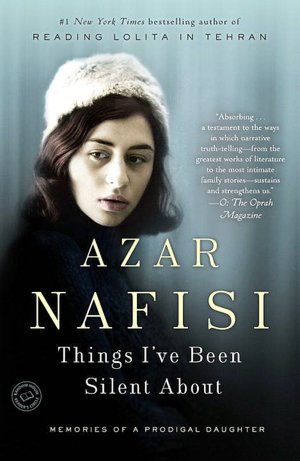
Things I've Been Silent About, Azar Nafisi


Things I've Been Silent About: Memories of a Prodigal Daughter
When one loves an Azar, how can one ignore a book written by an Azar?  That’s the dilemma I found myself embroiled in, within my head.  This book-by-Azar remained on my book group bookshelf, unread, for months.  It would jump out at me as I skimmed the shelf, yet I passed it by, over and over again.  It was both enticing and distasteful as it stared back at me.

It’s interesting about that bookshelf.  Here are the books I’ve toted home from book group, lined up on the shelf, waiting to be read.  Some have sat there for an embarrassingly long time.    Books that sounded enticing, worthwhile, interesting, exciting, or important for one reason or another.  But, when the time came to  select one, were passed by.

Things I’ve Been Silent About by Azar Nafisi sat and sat and sat on that shelf.  How many months ago did I bring it home?  I didn’t read it, but I couldn’t part with it. Azar, Azar, Azar stared at me.  I had to read it and when I finally did I greatly enjoyed it.  Thanks Betty Azar and thanks Azar Nafisi.

Much of my resistance to reading Things I’ve Been Silent About was that it was about Iran, a country both fascinating and distasteful to me. I didn’t want to read about ugly political turmoil, the suffering of people, or the control of women’s freedoms.  But that wasn’t what the book was about, although there was that too.

Instead it was about an exceptional woman, marriage, and a mother-father-daughter struggle.  It is an intimate look at Nafisi's family, the secrets she kept, and the price of political upheaval to a family.  One word I came across in the description of the book was dissection, and that fits.  Nafisi dissected her childhood experiences and relationships as she told her story.

Azar Nafisi is a good story teller, and the story, although difficult, was not depressing.
Another admirable woman and another wonderful memoir.

Tuesday, June 19, 2012

A Homemade Life, by Molly Wizenberg


I have not followed Molly Wizenberg’s food blog, Orangette—but reading this book, which arose from the blog, was very satisfying. It wasn’t just that the food parts are both tempting and entertaining. I found Wizenberg’s style forthright, funny, and reflective, with descriptive zingers that startled me and made me laugh. Easygoing, likeable… these are the kind of words that keep floating up. Even if you don’t care about the recipes, this book is fun to read.
I expected A Homemade Life to be enjoyable because I’d heard good things, but didn’t anticipate that I’d be in the bath with it until the water got cold—twice—because even after deciding to stop reading and get out (hence, not to add more hot water), a single sentence of the following chapter would draw me back in.
Wizenberg's syntax is admirable, something I notice and respect, and mention because one could be forgiven for not expecting such able writing from a blog-born book.
Her recipes are diverse, from the down-home (her father’s mayonnaise-heavy potato salad) to the sexy (tarte Tatin). In fact, I cherish her take on the latter:

…tarte Tatin is essentially a sexed-up apple pie—a housewife in stilettos, you could say. [Tantalizing vision of deep amber carmelized apples and puff pastry here.] Dolloped with crème fraîche, tarte Tatin doesn’t dally with small talk. It reaches for your leg under the table.
This is a gently meandering memoir organized around food. The happy Oklahoma childhood. The student years in Paris. The telling moment when, after her father dies of cancer, she plunges back into her studies—in Paris—but realizes that Foucault’s social theories no longer compel her. “My three years in graduate school, I now know, amounted to one big excuse to go back to Paris.” By the second week there, her research notes were being usurped by addresses for pastry shops and kitchen supply stores, and she knew she was quitting grad school to write about food. Now, as well as the blog, she writes regularly for Bon Appétit, and has been featured on NPR.org and PBS.org.

Oh, and there’s a love story in there, too. And, FYI, Wizenberg and her husband own and run Delancey, a pizza place in Ballard. She’s local! Did everybody know this except me?
Recommended for everyone who enjoys eating.
~ Paula

Tuesday, June 12, 2012

The Keep by Jennifer Egan


Kim wrote in an e-mail:

OK - I'm not even going to try to write a review for the blog about this book because I don't know how I would.

But, after trying - and quitting - so many books that were frustrating and disappointing  (why is it that most of the shortlisters and winners of the Man Booker Award seem to be more for writers than readers, i.e., all about the writing and not so much about the story) I'm pretty charged up about  "The Keep" by Jennifer Egan. I loved this book - it's extraordinarily well written and entertaining.  You could say it's a gothic tale - or that it's a story of redemption - or a modern day crime story - or all of the above.  And it's a mind bender - even now, I can't tell you what's real about it and what's not (i.e., there's a related web site that will keep you guessing!) It's gripping - and funny - and a cliff hanger til the end!  I couldn't put it down!

And with all that, it is still "serious fiction", i.e., the author was a finalist for the National Book Award for her first book, "Look at Me.

Do you remember reading John Fowles "The Magus" - kind of uncategorizable? That's this book too.  Try it! You'll like it."

~ Kim

(Posted by Fran, with permission from Kim, because her "review" sure did make me want to read The Keep!)

Monday, June 11, 2012

"Canada" by Richard Ford

I read my Best Fiction of 2012 this week.   Canada by Richard Ford is an outstanding work of art, made more so by the gentle, unhurried unfolding of its terrible tale. It begins:

“First, I’ll tell about the robbery our parents committed. Then about the murders, which happened later.”

So fifteen year-old Dell Parsons tells about the robbery that tore his family apart, dividing his life into “before” and “after”, and how his mother, his father, his twin sister and he each found their way into new lives. Told with Ford’s signature internal dialogs by the now-adult Dell, this is a haunting story of loss, broken trust, rebellion, the occasional kindness of strangers, and the shocking life decisions made by seemingly reasonable people.

There is nothing else to say: This is Ford’s masterpiece, a huge story, told by a heartbroken boy in a quiet, calm voice.  Fiction doesn't get much better than this.